The Evolution of K-Pop: From the 1990s to the Global Era
SEO Title: The Evolution of K-Pop: From the 1990s to the Global Era
Meta Description: Discover how K-Pop evolved from its 1990s roots into a global cultural phenomenon — explore each generation, key turning points, and what keeps the industry reinventing itself.
URL Slug: /evolution-of-kpop-1990s-to-global-era
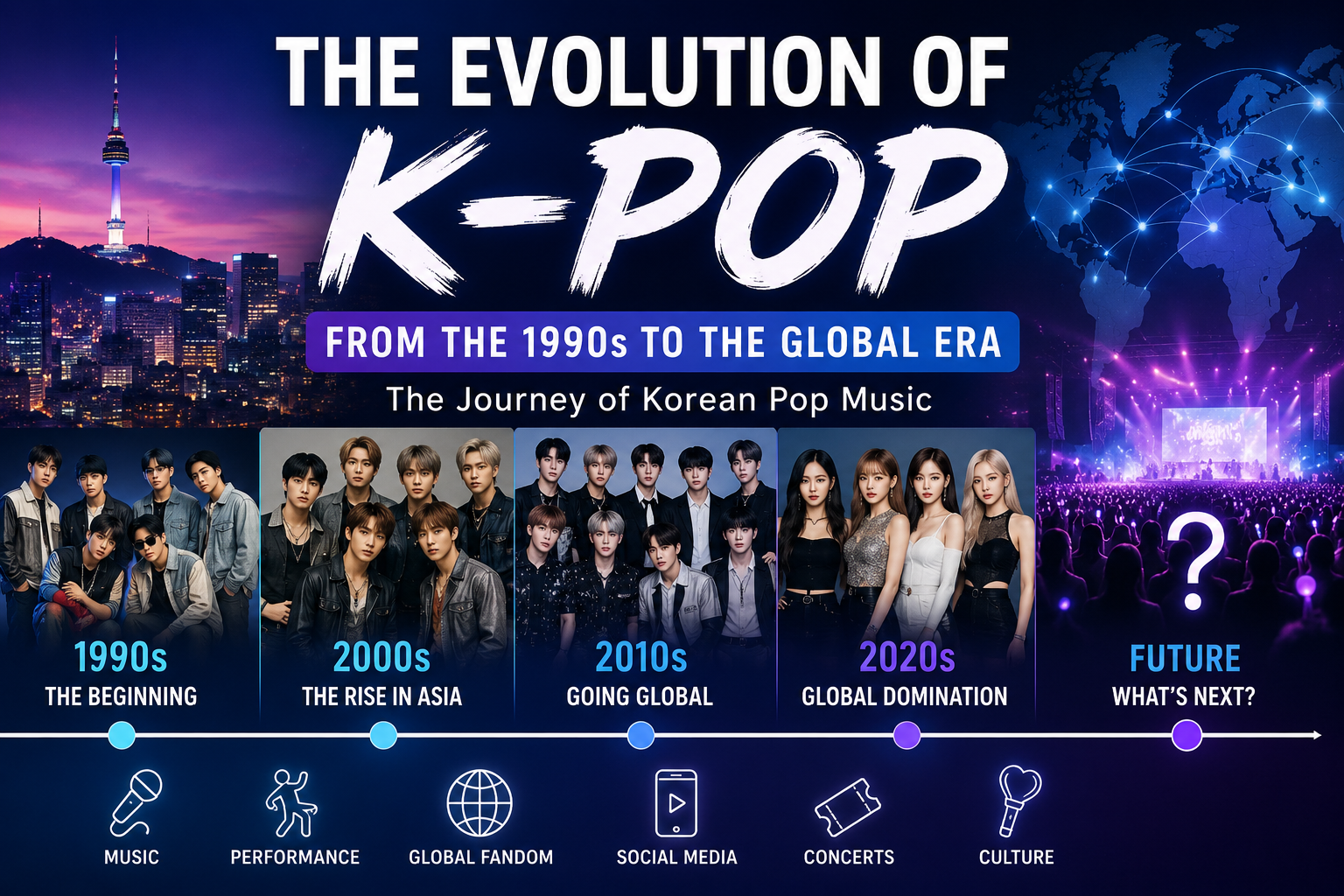
The Evolution of K-Pop: From the 1990s to the Global Era
K-Pop's rise to global prominence didn't happen overnight. It is the product of more than three decades of experimentation — in music production, performance training, marketing, and technology. What began as a regional pop movement in Seoul has grown into one of the most influential entertainment industries in the world, shaping trends in fashion, choreography, digital marketing, and fan culture far beyond South Korea's borders.
To understand how K-Pop reached this point, it helps to look at the industry generation by generation, tracing how each era built on the innovations of the one before it.
The 1990s: The Foundation of Modern K-Pop
The 1990s marked a turning point for Korean popular music. Before this decade, the domestic music scene was dominated by ballads and trot music, styles that had defined Korean radio for years. That began to shift as a new wave of artists started blending hip-hop, R&B, dance-pop, and Western pop influences into a distinctly Korean sound.
This experimentation didn't just change how the music sounded — it changed how the industry was built. Entertainment companies began developing a structured approach to artist development that combined vocal and dance training, media appearances, and coordinated fan engagement. This system became the blueprint for what is now recognized as the modern K-Pop idol model.
The First Generation
First-generation idol groups were instrumental in shaping the framework that later generations would refine. For the first time, music, choreography, fashion, and television presence were treated as parts of a single, unified concept rather than separate elements. Organized fan clubs also began to form during this period, laying the early groundwork for the highly engaged fandom culture K-Pop is known for today.
The 2000s: The Second Generation and Regional Expansion
The 2000s saw K-Pop move beyond Korea's borders and begin building an audience across Asia. This period is often referred to as the beginning of the "Korean Wave," or Hallyu — a broader cultural export that included Korean television dramas and variety programs alongside music.
As Korean dramas gained popularity in countries like Japan, China, and across Southeast Asia, interest in Korean music followed closely behind. Around the same time, the emergence of online video platforms gave international audiences direct access to Korean music videos and performances for the first time, without needing physical media or television broadcasts. This accessibility quietly set the stage for the much larger global expansion that would follow in the next decade.
The 2010s: The Third Generation Goes Global
If the 2000s were about regional growth, the 2010s were about global transformation. Social media platforms and video-sharing sites fundamentally changed the relationship between K-Pop artists and their fans. For the first time, artists could communicate directly with audiences anywhere in the world — sharing behind-the-scenes content, interacting in real time, and building relationships that didn't depend on traditional media gatekeepers.
This shift turned K-Pop fandom into something genuinely international. Fans in different countries began organizing online, translating content, and building communities that operated independently of geography. The result was a self-reinforcing cycle: stronger global fan engagement led to greater international visibility, which in turn attracted new fans.
The Fourth and Fifth Generations: Streaming, Short-Form Video, and Global Touring
The most recent generations of K-Pop artists have grown up in an entertainment landscape shaped by streaming platforms, short-form video content, and algorithm-driven discovery. Global touring has become a standard part of an artist's career rather than an occasional bonus, and international fans are now treated as a core part of the audience rather than a secondary market.
This has changed how music and content are produced from the very beginning. Companies now plan releases with global platforms and multilingual content in mind, rather than adapting a domestic release for international audiences after the fact.
Why Has K-Pop Continued to Evolve?
One of the defining characteristics of the K-Pop industry is its willingness to adapt. Rather than settling into a fixed formula, artists and entertainment companies consistently experiment with:
- New genres — blending pop with hip-hop, EDM, R&B, rock, and other influences
- International collaborations — working with producers, songwriters, and artists from outside Korea
- Digital platforms — adopting new streaming and social media formats early
- Global touring — building direct relationships with fans in international markets
- New visual concepts — evolving fashion, choreography, and music video aesthetics with each release cycle
- Social media strategies — creating content designed for direct fan interaction and shareability
This constant willingness to adjust — rather than any single formula — is arguably what has allowed K-Pop to stay culturally relevant across multiple decades and changing media landscapes.
Frequently Asked Questions
When did modern K-Pop begin? The early 1990s are generally considered the starting point for what is recognized today as the modern K-Pop idol system, when Korean artists began blending hip-hop, R&B, and dance-pop influences with a structured entertainment model.
How did K-Pop become a global phenomenon? A combination of factors contributed to K-Pop's global growth, including the rise of online video platforms, active social media engagement between artists and fans, international touring, and the development of highly organized, cross-border fan communities.
How many generations of K-Pop are there? There is no single, universally agreed-upon classification system, but the industry and its fans commonly discuss K-Pop's history in terms of several generations, each shaped by the technology and media landscape of its time.
What makes K-Pop different from other pop music industries? K-Pop is often distinguished by its structured artist training system, tightly coordinated multimedia concepts (music, fashion, and choreography developed together), and an unusually close, direct relationship between artists and international fan communities.