SEO Title
K-Pop Music Video Guide: What Makes Korean Music Videos Unique?
Meta Description
Discover what makes K-Pop music videos unique, from storytelling and choreography to fashion, visuals, editing, and cinematic production.
Focus Keyword
Main Keyword: K-Pop music videos
Secondary Keywords: Korean music videos, K-Pop MV, K-Pop video production, K-Pop choreography, K-Pop visual style, K-Pop storytelling, Korean pop culture
URL Slug
k-pop-music-video-guide
Article
K-Pop Music Video Guide: What Makes Korean Music Videos Unique?
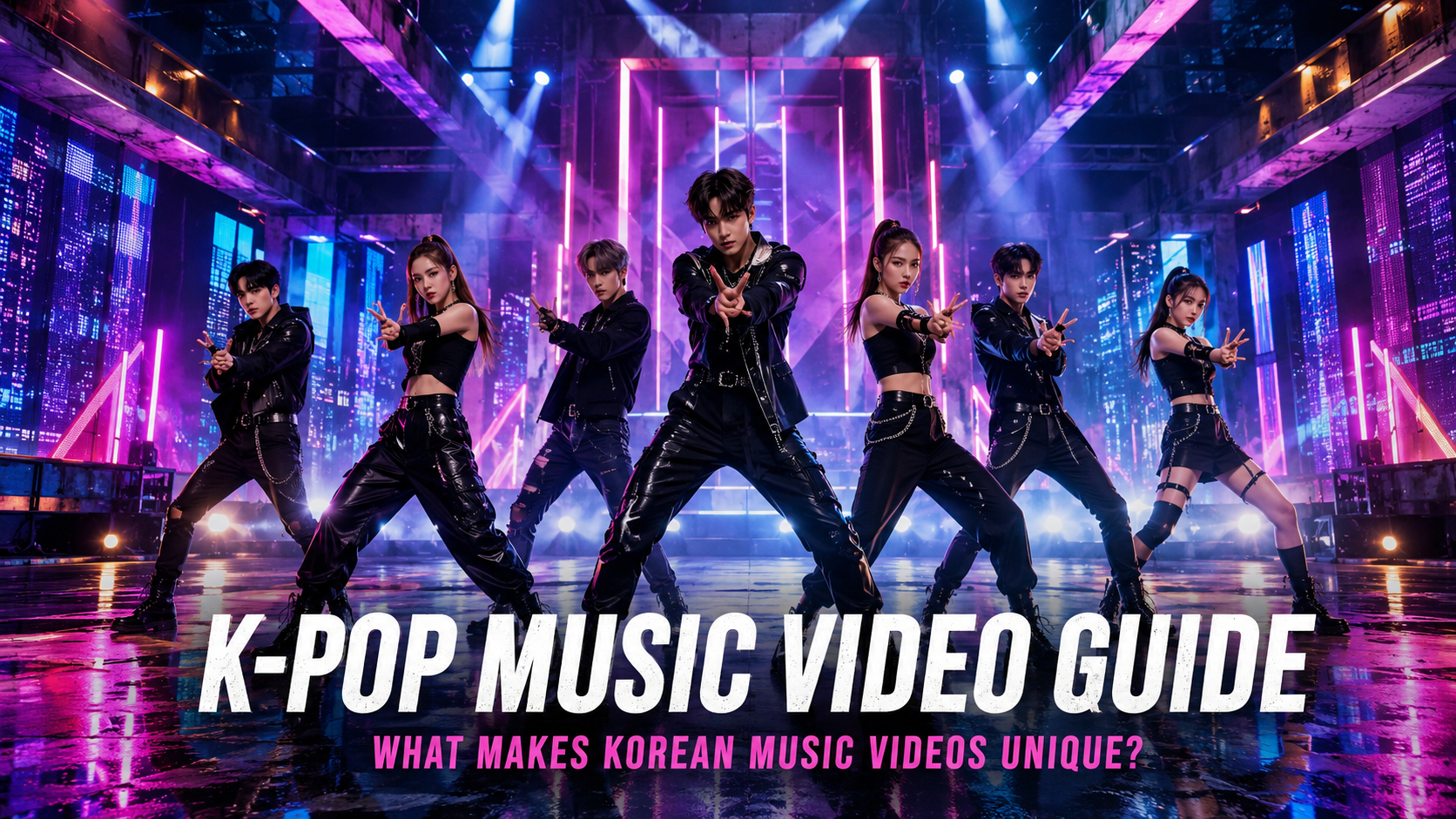
K-Pop music videos are more than visual companions to songs. They combine music, choreography, fashion, storytelling, cinematography, and visual design to create an experience that can be enjoyed even when viewers do not understand Korean.
From powerful dance performances to carefully designed sets and cinematic storytelling, K-Pop music videos have developed a distinctive visual identity. This guide explains the key elements that make Korean music videos different and why they attract audiences around the world.
What Is a K-Pop Music Video?
A K-Pop music video, often called an MV, is a professionally produced visual presentation of a Korean pop song.
Unlike a simple performance recording, a K-Pop MV can include several visual formats within the same video. These may include choreography scenes, narrative sequences, fashion-focused shots, close-ups, special effects, and cinematic locations.
The goal is often to strengthen the identity of the song and artist while giving fans additional visual details to discover.
Why Are K-Pop Music Videos So Visually Distinctive?
Several elements work together to create the recognizable style associated with K-Pop MVs.
Strong Visual Concepts
Many K-Pop music videos begin with a clear visual concept.
An artist may choose a futuristic, romantic, retro, mysterious, youthful, fantasy-inspired, or minimalist concept depending on the song and album. The concept influences everything from costumes and hairstyles to lighting, sets, camera movement, and color choices.
This consistency helps viewers immediately connect the visual world with the music.
Choreography as a Central Feature
Dance is one of the most important elements of many K-Pop music videos.
Choreography is not simply included as background entertainment. It can become part of the song's identity. Camera angles, formations, transitions, and editing are often designed around key dance movements.
A memorable choreography sequence can also encourage fans to recreate the dance through social media challenges and dance covers.
Storytelling in K-Pop Music Videos
Another important characteristic is the use of storytelling.
Some MVs present a straightforward narrative with a beginning, middle, and ending. Others use symbolic scenes, recurring objects, fictional characters, or visual clues that encourage viewers to interpret the story themselves.
This approach can make a music video feel more like a short film than a traditional promotional video.
Narrative vs. Performance Videos
K-Pop MVs can generally include different combinations of:
- Story-driven scenes
- Choreography performances
- Individual member shots
- Group performance scenes
- Conceptual or symbolic visuals
A single MV may move between these styles several times.
This variety keeps the visual experience dynamic and allows different members of a group to receive individual screen time.
Cinematic Camera Work and Editing
K-Pop music videos often use sophisticated cinematography and editing techniques.
Fast cuts can emphasize energetic sections of a song, while slower camera movements may create a dramatic or emotional atmosphere.
Common techniques include:
- Close-up shots
- Tracking shots
- Wide group formations
- Slow-motion sequences
- Rapid transitions
- Camera rotations
- Symmetrical compositions
- Visual effects
Editing is frequently synchronized with the rhythm and structure of the music, making the video feel closely connected to the song.
Fashion and Styling
Fashion is another major part of the K-Pop music video experience.
Artists may wear multiple outfits throughout a single MV. Styling can range from contemporary streetwear to luxury-inspired fashion, retro clothing, futuristic designs, or traditional Korean influences.
Hair and makeup are also carefully coordinated with the overall concept.
As a result, a K-Pop MV can introduce new fashion trends while reinforcing the artist's visual identity.
Elaborate Sets and Locations
K-Pop productions frequently use carefully designed environments.
A music video might take place in a colorful studio set, an urban environment, a futuristic room, a natural landscape, or a highly stylized fictional world.
Production design helps transform the song's concept into a physical visual environment.
Even simple objects can become important visual symbols when they are repeated throughout the video.
Color, Lighting, and Visual Mood
Color is often used intentionally to communicate emotion and atmosphere.
For example, bright colors may create a youthful and energetic feeling, while darker tones can contribute to a mysterious or dramatic mood.
Lighting can also change between sections of a song. This allows the visual atmosphere to evolve alongside the music.
The combination of color grading, lighting, costumes, and set design creates a unified visual language.
Korean Cultural Influences
Although K-Pop music videos are highly globalized, some incorporate elements of Korean culture.
These may include:
- Traditional Korean architecture
- Hanbok-inspired clothing
- Korean historical imagery
- Traditional patterns
- Korean landscapes
- Modern Korean city environments
These elements can be combined with contemporary pop aesthetics, creating a visual connection between Korean cultural identity and global entertainment.
The Role of Technology in K-Pop MVs
Technology has become increasingly important in music video production.
Computer-generated environments, virtual production, digital effects, advanced camera systems, and post-production techniques allow artists to appear in environments that would be difficult or impossible to create physically.
Technology can also help create transitions between realistic and fantasy worlds.
However, technology is usually most effective when it supports the song's concept rather than simply adding visual effects.
Why K-Pop Music Videos Encourage Repeat Viewing
One reason K-Pop MVs can generate strong fan engagement is their visual density.
Viewers may notice something different each time they watch the same video.
For example, a first viewing might focus on the choreography, while later viewings reveal:
- Background details
- Story connections
- Costume changes
- Symbolic objects
- Hidden visual clues
- Individual member moments
- Connections to previous releases
This encourages fans to analyze and discuss music videos together.
K-Pop Music Videos vs. Western Pop Music Videos
There is no single formula for either K-Pop or Western pop music videos. However, K-Pop productions are often particularly recognized for combining several entertainment elements in one visual package.
ElementK-Pop Music VideosGeneral Pop Music Videos
| Choreography | Often highly structured and prominent | Varies by artist and song |
| Visual concepts | Usually strongly coordinated | Varies |
| Fashion styling | Frequently central to the concept | Varies |
| Storytelling | Often combined with performance | Common but highly variable |
| Group formations | Important for idol groups | Less common for solo artists |
| Fan theories | Often strongly encouraged | Varies |
| Concept continuity | Can connect across releases | Varies |
The distinction is not absolute. Many international pop artists also use cinematic storytelling, elaborate choreography, and high-production visuals.
How to Watch a K-Pop Music Video Like a Pro
If you want to understand what makes a K-Pop MV unique, try watching it several times with a different focus each time.
First Watch: Focus on the Song
Listen to the melody, rhythm, vocals, and overall emotional atmosphere.
Second Watch: Watch the Choreography
Pay attention to formations, transitions, gestures, and how the camera follows the dancers.
Third Watch: Study the Visual Concept
Look at the costumes, colors, sets, lighting, and overall production design.
Fourth Watch: Look for the Story
Consider whether objects, locations, or scenes have symbolic meanings.
Fifth Watch: Notice the Details
Look for small visual elements that may connect different parts of the video or provide additional context.
This approach can make watching K-Pop music videos much more engaging.
What Makes a Great K-Pop Music Video?
A successful K-Pop music video does not necessarily need the biggest budget or the most complicated effects.
The strongest MVs usually create a clear connection between the music and visuals.
A great video can combine:
- A memorable visual concept
- Effective choreography
- Strong cinematography
- Consistent styling
- Engaging storytelling
- Appropriate editing
- Creative production design
- A clear artistic identity
When these elements work together, the music video becomes an important part of the song itself.
FAQ
What does MV mean in K-Pop?
MV stands for "music video." K-Pop fans commonly use MV as a short way to refer to an official music video.
Why is choreography important in K-Pop music videos?
Choreography helps communicate the energy and identity of a song. It can also make performances more memorable and create content that fans can recreate through dance covers and social media challenges.
Do all K-Pop music videos have a storyline?
No. Some focus mainly on choreography and visual performance, while others use detailed narratives or symbolic storytelling.
Why do K-Pop music videos have so many outfit changes?
Multiple outfits help represent different parts of a visual concept and allow the artists to present different styles throughout the video.
What makes K-Pop music videos different from regular music videos?
K-Pop MVs often combine choreography, fashion, storytelling, elaborate production design, and carefully coordinated visual concepts. However, there is no single formula, and many international artists use similar techniques.
Why do fans watch K-Pop music videos multiple times?
Repeated viewing can reveal choreography details, visual clues, styling changes, symbolic objects, and connections that may not be obvious during the first viewing.
Conclusion
K-Pop music videos are unique because they bring together music and visual storytelling in a highly coordinated way. Choreography, fashion, cinematography, production design, technology, and Korean cultural influences can all contribute to the final experience.
For new K-Pop fans, watching an MV is more than simply watching an artist perform a song. It can be an opportunity to explore a carefully constructed visual world and discover new details with every viewing.
Understanding these elements can help you appreciate why K-Pop music videos have become such an influential part of global pop culture.
'K-POP' 카테고리의 다른 글
| K-Pop Travel Guide: Best Places to Visit in Seoul for K-Pop Fans (0) | 2026.08.17 |
|---|---|
| K-Pop Concert Guide: How to Prepare for Your First K-Pop Concert (0) | 2026.08.17 |
| K-Pop Fandom Guide: Understanding ARMY, BLINK, ONCE and More (0) | 2026.08.16 |
| What Does “Comeback” Really Mean in K-Pop? (0) | 2026.08.16 |
| How K-Pop Idols Train: A Complete Guide to the Korean Idol System (0) | 2026.08.16 |


