SEO Title: Top K-Pop Groups That Changed the Global Music Industry
Meta Description: Discover the K-Pop groups that transformed the global music industry through innovation, fandom power, world tours, and cultural influence.
URL Slug: /top-kpop-groups-changed-global-music-industry
Focus Keyword: K-Pop groups that changed the global music industry
Related Keywords: K-Pop global success, K-Pop industry, BTS, BLACKPINK, EXO, TWICE, Korean Wave, K-Pop fandom, global K-Pop
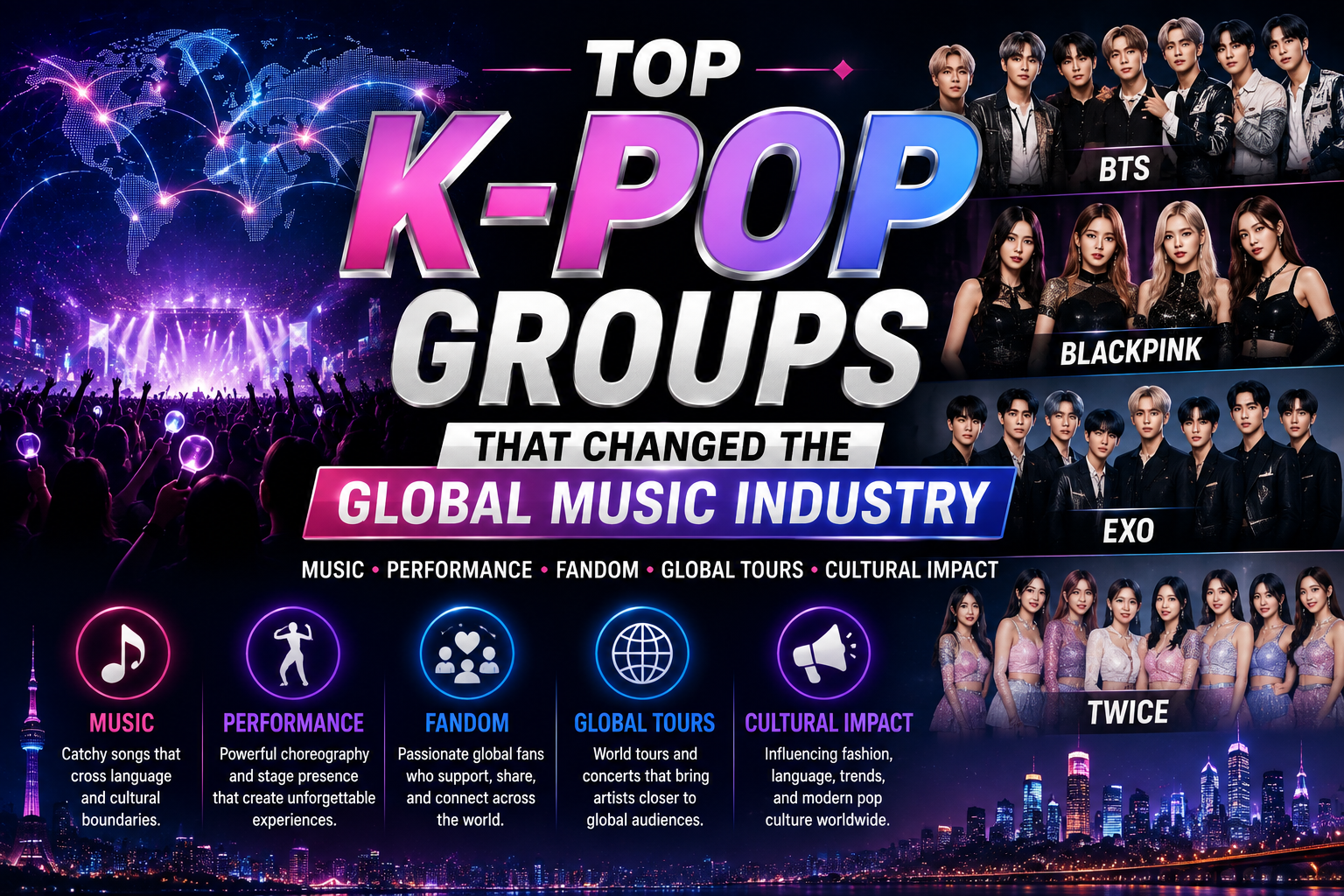
Top K-Pop Groups That Changed the Global Music Industry
K-Pop has evolved from a primarily Korean entertainment scene into a global music and cultural phenomenon. Behind this transformation are artists and groups that helped expand the international audience for Korean music and changed how global fans discover, consume, and interact with artists.
The growth of K-Pop has not been driven by music alone. Performance, social media, visual storytelling, fashion, international touring, and highly engaged fandoms have all contributed to the industry's expansion.
Among the many successful groups, several stand out for the different ways they helped reshape the global music landscape.
BTS – Opening the Global Door for K-Pop
BTS played an important role in bringing K-Pop to a much wider international audience.
The group's combination of music, performance, storytelling, and direct communication with fans helped demonstrate that Korean-language music could connect with listeners across cultural and language boundaries.
BTS and Global Fandom
One of BTS's most significant contributions was the development of a highly engaged international fan community.
Social media allowed the group to communicate directly with fans while supporters created translations, fan content, discussions, and online communities around the world.
This demonstrated how digital fandom could become an important part of a modern music career.
BTS and the Global Music Market
BTS also helped increase international attention toward Korean music and culture.
Their achievements in major global music markets demonstrated that language did not necessarily prevent an artist from developing a large international audience.
Their success also encouraged greater interest in other Korean artists.
BLACKPINK – Connecting K-Pop With Global Pop Culture
BLACKPINK represents another important stage in the international development of K-Pop.
The group combined K-Pop's performance-focused approach with elements of global pop, fashion, luxury branding, and international collaborations.
Music and Fashion
BLACKPINK's influence extends beyond music.
Their members have developed strong relationships with international fashion and beauty brands, helping connect K-Pop with global lifestyle and fashion culture.
This has contributed to the growing visibility of Korean artists outside traditional music audiences.
International Collaborations
Collaborations with international musicians also helped introduce BLACKPINK to listeners who may not have previously followed K-Pop.
These partnerships illustrate how the K-Pop industry has increasingly become connected to the wider international music business.
Social Media and Visual Identity
BLACKPINK's strong visual identity also works particularly well across social media platforms.
Music videos, performances, fashion content, and short-form videos can reach audiences far beyond the original Korean market.
EXO – Expanding K-Pop Across Asia
EXO represents an important stage in K-Pop's expansion throughout Asia.
During the group's rise, K-Pop was developing a stronger presence in markets including Japan, China, and Southeast Asia.
Building International Fan Communities
EXO demonstrated how a K-Pop group could establish a strong fan base beyond Korea.
Their music releases, performances, multilingual activities, and international promotions contributed to the development of a broader regional audience.
The Importance of the Asian Market
K-Pop's global story did not begin entirely in Western markets.
Asian countries played a critical role in the development of the Korean Wave.
The success of groups such as EXO helped demonstrate the commercial potential of cross-border K-Pop fandom and contributed to the industry's international foundation.
TWICE – The Power of Global Fandom
TWICE provides another example of how a K-Pop group can develop a powerful international fan community.
Their recognizable songs, choreography, visual concepts, and consistent interaction with fans helped them build audiences across multiple markets.
Japan and International Growth
Japan has historically been an important market for Korean entertainment.
TWICE's success in Japan demonstrated how a K-Pop group could build a strong presence outside Korea while maintaining its Korean identity.
Connecting Through Social Media
Digital platforms have also played an important role in TWICE's international reach.
Fans can discover music videos, performances, interviews, and behind-the-scenes content regardless of their location.
This type of accessibility has become a defining feature of modern K-Pop.
What Do These K-Pop Groups Have in Common?
Although BTS, BLACKPINK, EXO, and TWICE have different musical identities, several common factors helped them develop international audiences.
Strong Musical Identity
Successful groups need recognizable music and a clear artistic identity.
Performance
K-Pop's emphasis on choreography and live performance provides an additional visual dimension to the music.
Digital Communication
Social media has reduced the distance between artists and fans.
Global Touring
International concerts allow artists to build direct relationships with audiences in different countries.
Dedicated Fandoms
Highly engaged fans can help create visibility around music releases, performances, and cultural conversations.
How K-Pop Changed the Global Music Industry
The influence of K-Pop extends beyond individual artists.
The industry has demonstrated several important changes in the modern music business.
Music Can Cross Language Barriers
K-Pop has shown that audiences can connect with music even when they do not understand every lyric.
Emotion, melody, performance, visual storytelling, and fan communities can all contribute to international appeal.
Fandom Has Become a Global Network
Fans are no longer limited by geography.
Digital communities allow listeners from different countries to participate in the same conversations, releases, and events.
Artists Are Becoming Global Brands
Modern K-Pop artists increasingly operate across music, fashion, beauty, advertising, entertainment, and digital media.
This broader approach has helped transform the role of the pop artist.
Concerts Have Become Global Experiences
International touring has become an important part of K-Pop's global expansion.
Large-scale concerts allow artists to turn online communities into physical fan experiences.
The Future of the K-Pop Industry
The next stage of K-Pop will likely continue to be influenced by streaming, short-form video, artificial intelligence, virtual experiences, international collaborations, and changing fan behavior.
However, the fundamental strengths of K-Pop remain familiar: music, performance, visual creativity, and strong relationships between artists and audiences.
The groups that helped build the global K-Pop industry have created a foundation for future artists to continue expanding into new markets.
Frequently Asked Questions
Which K-Pop groups changed the global music industry?
BTS, BLACKPINK, EXO, and TWICE are among the groups that played important roles in expanding K-Pop's international audience, although many other artists contributed to the Korean Wave.
Why did BTS become globally successful?
BTS combined music, performance, storytelling, social media communication, and strong fan engagement to build an international audience.
How did BLACKPINK influence global pop culture?
BLACKPINK helped connect K-Pop with international music, fashion, beauty, social media, and brand culture.
Why is EXO important to K-Pop history?
EXO helped strengthen K-Pop's presence across Asian markets during an important period of international expansion.
How did TWICE build an international fandom?
TWICE combined memorable music and choreography with consistent releases, digital engagement, and international activities.
Why is K-Pop different from other music industries?
K-Pop often combines music, choreography, visual concepts, fashion, social media, artist development, and fandom into one integrated entertainment experience.
Conclusion
The global success of K-Pop is the result of many artists, producers, entertainment professionals, and fans working within an evolving industry.
BTS helped demonstrate the potential of Korean music in the global mainstream. BLACKPINK connected K-Pop with international pop and fashion culture. EXO helped expand the industry's influence across Asia, while TWICE demonstrated the power of international fandom.
Together with many other artists, these groups helped transform K-Pop from a regional music phenomenon into a major part of the global entertainment landscape.
Internal Link Keywords
- The Evolution of K-Pop: From the 1990s to the Global Era
- Why Is K-Pop So Popular Worldwide?
- A Beginner's Guide to K-Pop
- K-Pop Fandom Guide
- K-Pop Comeback Explained
- K-Pop Music Video Guide
'K-POP' 카테고리의 다른 글
| What Does “Comeback” Really Mean in K-Pop? (0) | 2026.08.16 |
|---|---|
| How K-Pop Idols Train: A Complete Guide to the Korean Idol System (0) | 2026.08.16 |
| The Evolution of K-Pop: From the 1990s to the Global Era (0) | 2026.08.16 |
| K-Pop Beginner's Guide (0) | 2026.08.16 |
| BTS 2026–2027 World Tour ARIRANG: Schedule, Stadiums and Ticket Guide (0) | 2026.08.16 |


